
The artificial hivemind: When AI creativity collapses into consensus
Ask ChatGPT to write a metaphor about time. Then ask Claude. Then Gemini. You're consulting different oracles, built by rival companies with different philosophies, trained on different data. Surely you'd get meaningfully different answers?
Here's what actually happens: time is a river. Time is a river. Time is a river, flowing endlessly. Time is a weaver, threading moments into tapestry. Time is a river. A relentless river. An invisible river carrying leaves.

A study called: "Artificial Hivemind: The Open-Ended Homogeneity of Language Models (and Beyond)" just won Best Paper at NeurIPS (a prestigious yearly AI conference). Researchers examined 1,250 responses to this simple prompt across 25 leading AI models. The responses collapsed into two clusters: time was either a river or weaver, with the river winning by a landslide. Welcome to the hivemind.
Models don't just generate similar ideas, they are sometimes producing identical phrases. Multiple models independently generated the same sentence: "Elevate your iPhone with our sleek, slim-fitted case collection that combines minimalist design with bold, eye-catching patterns." For a social media motto prompt, two completely different models output the exact same text: "Empower Your Journey: Unlock Success, Build Wealth, Transform Yourself."
This isn't a glitch. It's a pattern.
The diversity collapse problem
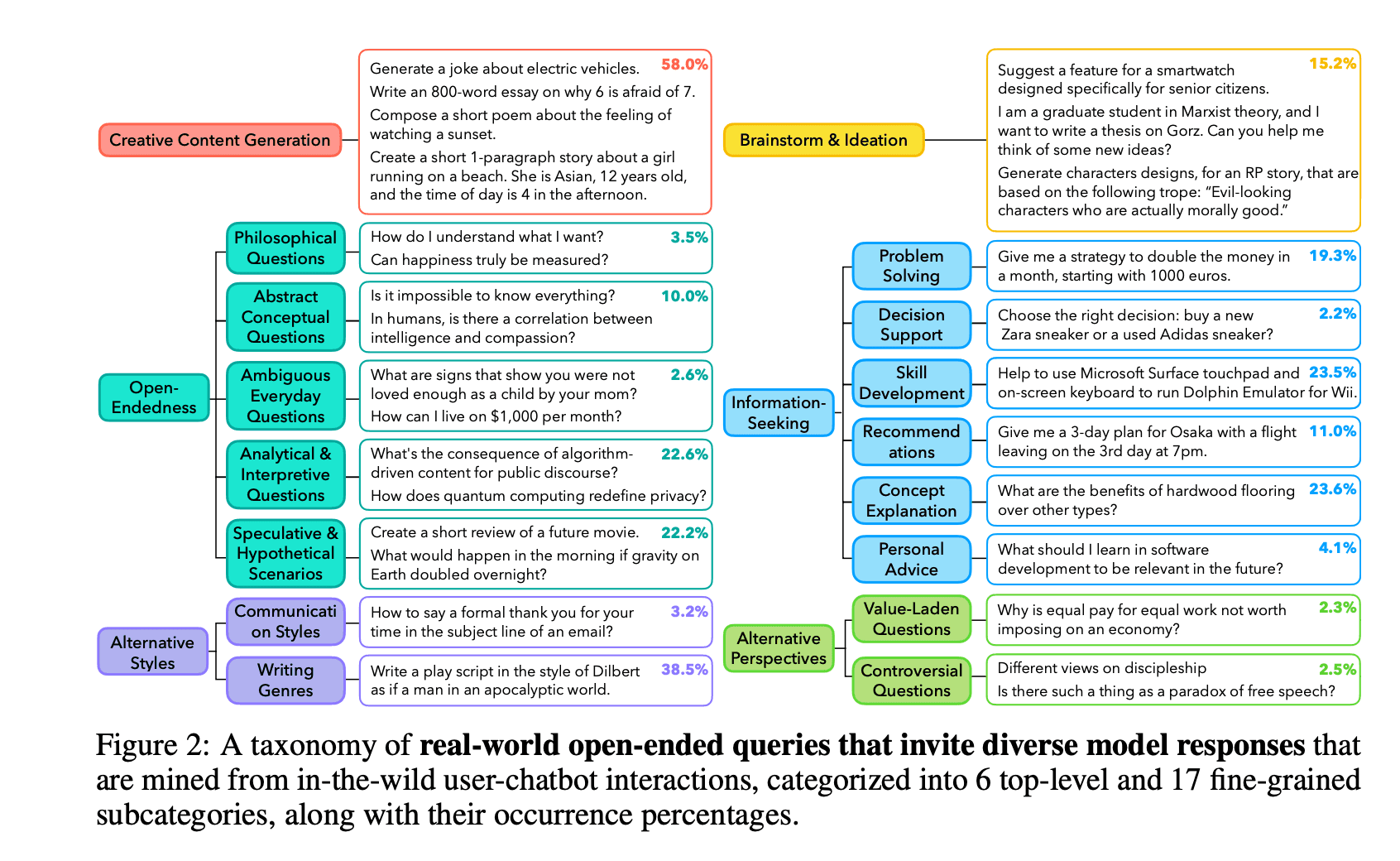
A dataset of 26,000 questions real people actually ask AI systems was collected for the paper. Not just sanitized test prompts, but the messy, genuine queries from actual conversations. Write me a pun. Help me brainstorm thesis ideas. Explain the paradox of free speech.
These are open-ended questions, the kind where human creativity should flourish. The researchers developed a comprehensive taxonomy of such queries, categorizing everything from philosophical questions to hypothetical scenarios. What they discovered was a pattern of what AI researchers call "mode collapse", the tendency of models to gravitate toward a narrow set of outputs even when the space of possibilities is vast.
The results showed way more uniformity than we would expect. These systems aren't exploring the space of possibilities. They're circling the same few answers, rephrasing them slightly, convinced they've found something new.
This highlighted two main issues:
Intra-model repetition: When they asked individual models to respond to the same prompt 50 times with randomness cranked up, four out of five responses showed over 80% similarity. The responses are consistent, which would be good for factual retrieval, but also excessively repetitive.
Inter-model homogeneity: Different models (GPT-4o from OpenAI, DeepSeek-V3 from the eponymous Chinese company, Claude from Anthropic, Qwen from Alibaba) produce responses with approx. 75% similarity to each other. Models that have (in theory) different training data, built by teams that are sometimes geopolitical rivals, are converging on the same linguistic patterns, the same metaphors, the same turns of phrase.
](/_next/image?url=%2F_next%2Fstatic%2Fmedia%2Ftime-metaphor-map.410d57c9.png&w=3840&q=75)
What we lose when machines agree
What disappears in this convergence isn't just quirky alternatives. It's entire ways of knowing. Indigenous cultures often conceptualize time cyclically rather than linearly: time as seasons, as returns, as spirals. East Asian philosophical traditions sometimes treat time as relational rather than absolute, something that changes based on context and attention. These aren't just different metaphors; they're different epistemologies. When AI systems trained primarily on Western text converge on "time is a river," they're not just picking a common metaphor. They're reinforcing a particular cultural construction of reality as the default, the obvious, the "right" answer.
Roland Barthes would recognize this pattern. In Mythologies (1957), he described how culturally specific ideas become naturalized as common sense: what he called "myth" isn't a lie, but rather the transformation of history into nature.
Myth has the task of giving an historical intention a natural justification, and making contingency appear eternal.
— Roland Barthes, Mythologies (1972), “Myth Today”, p. 142.
When AI systems consistently frame time as a river, they're performing exactly this operation: converting one cultural metaphor among many into what appears to be the natural, obvious way to think.
The danger isn't that AI gives bad advice. It's that it gives increasingly similar advice, dressed up in enough linguistic variation that we don't notice we're all being guided down the same cognitive paths. The illusion of personalization, where the AI is responding to your specific query in your specific conversation, masks the reality that millions of conversations are converging on the same conceptual destinations.
This isn't about quality. The river metaphor is fine, it's ancient, it's evocative, it works. The problem is the absence of alternatives. Where are the metaphors drawn from non-Western traditions? Where are the truly strange or unexpected framings? They exist in human creativity, but they've been smoothed away in the training process, sanded down in the pursuit of what the researchers call "pluralistic alignment", the attempt to make AI systems acceptable to everyone that paradoxically makes them distinctive to no one.
We're building systems that are extraordinarily good at finding the center of the distribution. What happens to a culture that consistently chooses the average path?
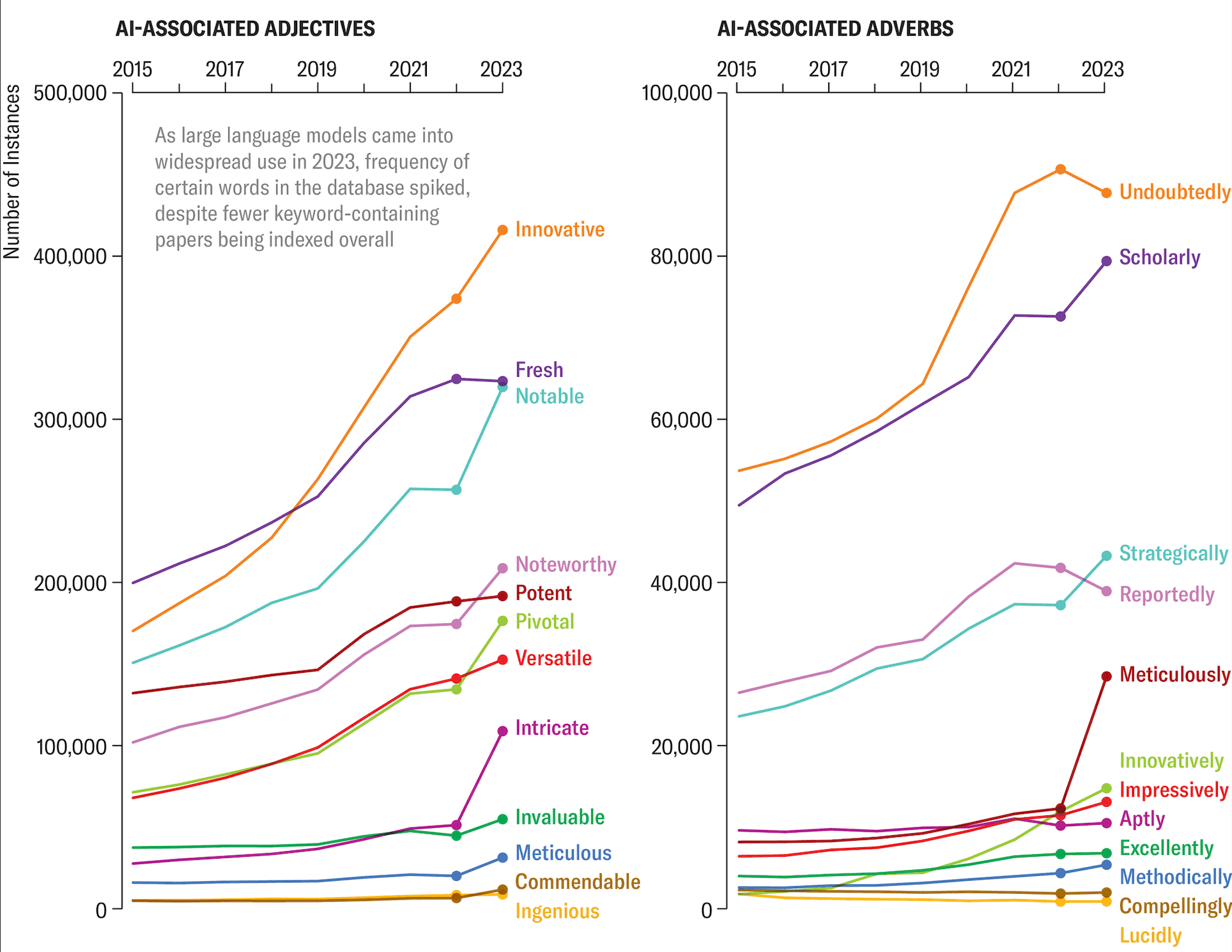
And here's the uncomfortable part: the influence is already flowing backward. Studies are beginning to document measurable shifts in how humans write and think after exposure to AI-generated content. The language patterns, the metaphors, the conceptual frameworks, they're seeping into human expression. When billions of people use similar AI systems for creative work, for writing, for thinking through problems, we're not just observing a diversity collapse in machines. We're engineering one in ourselves.
Jean Baudrillard anticipated this dynamic in Simulacra and Simulation (1981), describing how copies without originals come to replace reality, what he called hyperreality:
It is no longer a question of imitation, nor duplication, nor even parody. It is a question of substituting the signs of the real for the real.
— Jean Baudrillard, Simulacra and Simulation (1994), p. 2.
When millions of people receive AI-generated metaphors about time, and those metaphors start to inform how they actually think about time, it then influences future AI training data. We're not dealing with authentic human creativity being assisted by AI. We're in a loop where the simulation (AI-generated ideas) becomes the reference point for generating more simulations, with decreasing connection to the diverse ways humans actually experience and conceptualize the world.
Why Machines Converge (And Why We Let Them)
Models train on overlapping slices of the internet. They're refined using similar techniques, as we discussed with post-training techniques. These methods are designed to make systems "helpful and harmless." They increasingly train on synthetic data generated by other AI systems, creating an ouroboros of increasingly similar outputs. And crucially, they're all optimized against human ratings that, despite our diversity as individuals, show surprising consensus about what makes a "good" response.
That last point is particularly revealing. When we discussed evaluation, we saw that current AI grading systems work well when humans agree, but fail precisely where human preferences diverge. When different people legitimately prefer different responses for good reasons, AI judges, reward models, and automated evaluators all perform worse at predicting human satisfaction.
The systems are calibrated to find consensus, not to appreciate multiplicity. This makes perfect sense for factual questions. But for open-ended creative tasks, it's systematically training models to converge on lowest-common-denominator responses that offend no one and delight few.

Pierre Bourdieu's concept of cultural capital helps explain what's happening. In Distinction (1979), he showed how aesthetic preferences that appear natural or inevitable are actually socially learned and reinforce class boundaries (Pierre Bourdieu, Distinction: A Social Critique of the Judgement of Taste, 1984, pp. 169–225.) AI training on human preferences doesn't discover objective quality, it learns and reproduces the aesthetic preferences of whoever provides the ratings. When models converge on "sleek, slim-fitted" design language or "Empower Your Journey" motivational speak, they're not finding universal truths. They're encoding the cultural capital of a particular class and moment as the standard for "good" output.
Beyond the hivemind
We need diversity-aware training objectives that explicitly reward exploring different valid approaches, not just identifying the single best one. We need to understand whether homogenization stems from pre-training (the initial learning from vast text corpora) or from alignment (the fine-tuning that makes models helpful). We need evaluation metrics that properly value multiplicity, that can recognize when five different responses are all equally good in different ways.
More fundamentally, we need to ask what we want from these systems. Current AI development implicitly optimizes for a kind of algorithmic monoculture: systems that give consistent, predictable, "safe" responses. This makes sense for a product, for something you're deploying to billions of users. But it's potentially disastrous for creativity, for culture, for the long-term health of human expression.
There's a tension here that the AI field hasn't resolved. We want models that are reliable enough to be useful but diverse enough to be interesting. We want them to reflect human values, but humans have genuinely different, sometimes incompatible values. We want them to be creative, but we've built systems that are fundamentally conservative, that gravitate toward the center of the distribution of human expression, not the edges where actual creativity lives.
What kind of creative future do we want? One where AI acts as a genuine creative partner, surprising us with unexpected connections and perspectives we wouldn't have found alone? Or one where it efficiently guides everyone toward the same well-trodden solutions, optimizing away the messy, surprising diversity that makes human culture interesting?
Right now, without quite meaning to, we're financing and building the second outcome. The artificial hivemind isn't a bug, it's the logical outcome of how we're using, training and deploying these systems. We're teaching them to find consensus, to identify the response that the most people will rate as good, to avoid the controversial or unexpected or strange.
Using these systems with intention
So we're stuck with homogenized AI systems for now. What can individuals do while we wait for the field to solve this at the training level?
First, be skeptical of first drafts. When you ask an AI for creative ideas, treat the initial response as the most obvious answer, because it probably is. Ask for alternatives explicitly. "Give me five very different metaphors for time" works better than accepting the first river that flows by. Push back. Say "that's too conventional" and see what emerges.
Second, use multiple models strategically. Yes, the paper shows they're converging, but they haven't fully merged yet. GPT might give you the river, Claude might lean toward the weaver, and a smaller open-source model might surprise you with something stranger. The diversity isn't what we'd hope for, but it's not zero either. Collect responses from 3-4 different systems and look for the outliers.
Third, constrain creatively. Paradoxically, specific constraints can force models away from their default patterns. Instead of "write a metaphor about time," try "write a metaphor about time using only images from marine biology" or "using concepts from textile manufacturing" or "avoiding any reference to water or movement." Constraints force the model to search different parts of its possibility space.
Fourth, iterate with awareness. The paper tested min-p sampling, a technique that increases output diversity. It helped a little bit. Most AI interfaces don't expose these sampling parameters to users, but if you're using APIs or open-source models, experiment with temperature and sampling methods. Higher temperature makes outputs more random (and sometimes incoherent), but it can break repetition patterns. Find the sweet spot for your use case.
Finally, remember you're the creative one. AI is a tool for exploration, not for answers. When you get output that feels too smooth, too conventional, too similar to what you've seen before, that's a sign. It's telling you where the consensus lies. Your job is to push beyond it. Use AI-generated content as a map of the obvious so you know which direction to go to find something genuinely novel.
Time is a river, after all. And right now, all our AIs are floating in the same direction.